.jpg)
“Spring of Nations” 2.0: How to Preserve the Liberation Revolution
Through the prism of time, we can see processes that constantly repeat themselves. One such example is the collapse of empires. Russia is no exception. Today, the time has come to discuss the nationalist and democratic alliances of various groups from Ukraine and the Idel-Ural region, a topic that has been little studied.
Through the prism of time, we can see processes that constantly repeat themselves. One such example is the collapse of empires. Russia is no exception. Today, the time has come to discuss the nationalist and democratic alliances of various groups from Ukraine and the Idel-Ural region, a topic that has been little studied.
We should begin by asking: have there been such unions in world history? Absolutely. And to do this, we need to analyze the history of the 19th century, specifically its first half. After the Napoleonic Wars, nationalist, democratic, and liberal movements and organizations began to spread across Europe and the Russian Empire. Their goal was to establish a truly just society based on the harmony of equality before the law, national orientation, and the continuation of traditions. Despite the widespread myth that all of them were “anti-traditional,” this is not true.
For example, in Germany, since 1815, there has been an entire network of so-called “Burschenschaft”—student nationalist associations whose goal is to create a unified Germany with economic and cultural opportunities and rights that would safeguard the interests of both the peasantry and the bourgeoisie and aristocracy. And despite all possible prohibitions (for example, the Karlsbad Decrees of 1819), they continue to exist to this day.
Or consider the entire educational circles in France, operating semi-underground during the same period. Their goal was to rethink the French Revolution, take into account all possible mistakes, and so on.
What unites them? A common enemy—absolutist monarchies that violated the very norms of conservatism, thus creating the Reaction. Although each of these movements in their respective countries was focused on its own national interests, up until 1849, they were fully integrated into a kind of “pan-European” network of resistance to existing tyranny.
The 1848–1849 revolution itself, from its beginning to its middle, reflected positive changes, expressed in the writing and adoption of constitutions, the creation of opportunities for the comprehensive development of the market and, consequently, the economy. There was no leftist lie about “class suppression.” After all, the idea that workers, peasants, and others were supposedly trapped in a hopeless, enslaved position under both the “Old Regime” and the “bourgeoisie” emanated from the milieu of “intellectualized marginalism”—that is, people who, through literary and ideological writing, desired to create a “free new world.”
The problem, however, is that such a world would be built on the absolute denial of individual freedom as a subject, as well as all spiritual benefits (particularly national and religious ones), in the name of the “dictatorship of the proletariat.” Due to the rapid spread of this kind of populism, the Spring of Nations itself collapsed, although the prospects, again, were colossal.
And here it’s worth turning to our reality. Today, in the occupied territories of Ukraine, there are underground literary, youth, ideological, and other movements and organizations whose goal is to liberate Ukraine from the transformed form of the Soviet Union—the Russian Federation.
I also believe that similar groups exist in the Caucasus, Siberia, and Idel-Ural. Although the members of such movements may profess different religions, belong to various groups, and hold diametrically opposed views, they are still united by a single goal: the destruction of the Russian Federation as a state.
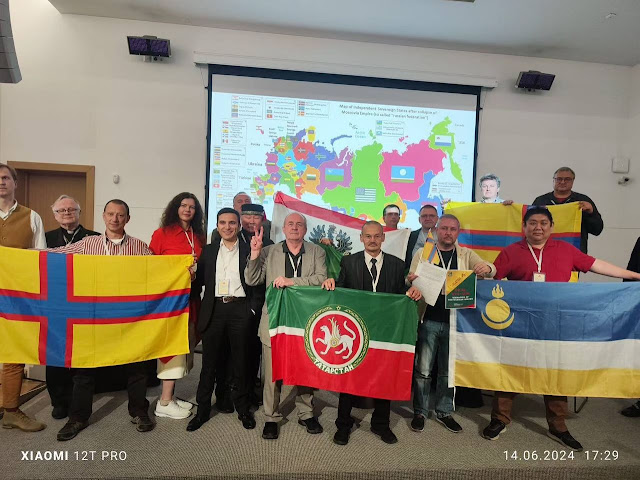
Here, we can analyze one situation using a practical example—the Anti-Imperialist Bloc of Nations. This organization, created by Ukrainian nationalists, unites representatives of dozens of oppressed peoples and maintains free relations with democratic forces in Europe and the United States. Within the ABN itself, numerous democratic organizations exist.
One such organization is the Government of Independent Tatarstan in Exile, headed by Rafis Kashapov. As someone who interacts with representatives of this organization, I can say that their work, like that of many similar organizations, is often underestimated. But it is precisely by establishing contacts with such groups and creating a full-fledged underground and official resistance network in the Russian Federation that the main goal of the 21st century can be realized: the destruction of the remnants of totalitarianism.
But it’s important not to succumb to leftist provocations and dogmas, lest the future liberation “revolution” that will take place be in vain and lose its meaning. We, Ukrainians, Tatars, Bashkirs, Khanty, Nokhchi, and others, have no moral right to give leftist forces a chance to revive and dictatorship their law, based on the distortion of the traditions of entire ethnic groups, for they will destroy us all.
Here, we can emphasize that the Russian Federation itself is essentially a re-created/reborn USSR in a more dangerous form, since it is based on digital control and the attraction of world politicians and ideas to the empire’s advantage.
The New Spring of Nations will require clear national and democratic coverage so that everyone understands that a struggle for freedom is underway.
In conclusion, I would like to say only one thing: do not limit yourself to a narrow vision of only your own country, look at the situation more broadly and do everything to ensure that totalitarianism never reigns in the world again.
Glory to Ukraine! Alga Tatarstan!
Matvey Bondar, civil activist, Ukraine
Правительство Независимого Татарстана
https://abn.org.ua/en/liberation-movements/spring-of-nations-2-0-how-to-preserve-the-liberation-revolution/
https://tatar-toz.blogspot.com/2026/09/spring-of-nations-20-how-to-preserve.html